Generative AI is transforming how organizations innovate, automate workflows, and enhance customer experiences. As enterprises move from experimentation to large-scale AI adoption, the demand for skilled professionals continues to grow.
The AWS Certified Generative AI Developer certification validates the ability to build, deploy, secure, and optimize AI-powered applications using AWS services. For organizations, it ensures access to qualified talent capable of delivering scalable and reliable AI solutions. For professionals, it provides a valuable pathway to career growth in enterprise AI.
What is the AWS Certified Generative AI Developer Certification?

The AWS Certified Generative AI Developer certification is a professional credential that validates an individual’s ability to build, deploy, secure, and optimize Generative AI applications using AWS technologies. The certification focuses on practical skills required for enterprise AI development and demonstrates proficiency in working with modern AI architectures and cloud-native services.
Key areas covered include:
- Foundation Models
- Large Language Models (LLMs)
- Prompt Engineering
- Retrieval-Augmented Generation (RAG)
- AI Application Development
- Model Evaluation and Optimization
- Responsible AI
- AI Governance and Security
- Enterprise AI Deployment
By earning this certification, professionals prove they can develop production-ready AI solutions that align with enterprise requirements and industry best practices.
Why Enterprise Generative AI Is Driving Demand for Certified Professionals
Organizations across industries are investing heavily in Enterprise Generative AI to improve productivity, automate repetitive tasks, enhance customer experiences, and accelerate innovation. However, successful implementation requires more than access to advanced AI models.
Enterprises need professionals who can integrate AI into business workflows, manage cloud infrastructure, optimize performance, ensure security, and maintain compliance standards. As AI projects scale, organizations increasingly seek professionals with validated expertise who can bridge the gap between AI experimentation and enterprise deployment.
Benefits of AWS Certified Generative AI Developer Certification
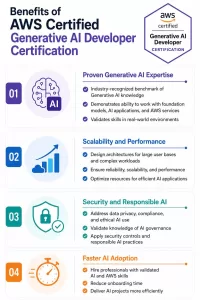
Proven Generative AI Expertise
The certification serves as an industry-recognized benchmark of Generative AI knowledge. It demonstrates a professional’s ability to work with foundation models, AI applications, and AWS services in real-world environments.
Scalability and Performance
Enterprise AI applications often need to support large user bases and complex workloads. Certified professionals understand how to design architectures that ensure reliability, scalability, and performance.
Security and Responsible AI
Organizations must address concerns related to data privacy, compliance, and ethical AI use. The certification validates knowledge of AI governance, security controls, and responsible AI practices.
Faster AI Adoption
Companies can accelerate AI implementation by hiring professionals who already possess validated AI and AWS skills. This reduces onboarding time and helps teams deliver projects more efficiently.
Key Skills Covered in the AWS Generative AI Certification
One of the biggest strengths of the AWS Generative AI Certification is its focus on practical, job-ready skills.
Professionals learn how to work with foundation models and Large Language Models (LLMs), develop effective prompts, build AI-powered applications, and evaluate model performance. The certification also emphasizes Retrieval-Augmented Generation (RAG), a widely adopted architecture for connecting AI models with organizational knowledge bases to improve response accuracy.
Candidates also gain exposure to AI governance, security implementation, model optimization, and enterprise deployment strategies. These skills are critical for building reliable and business-ready AI solutions.
Key AWS Services Used in Generative AI Development
Professionals preparing for the AWS Certified Generative AI Developer Exam should understand several AWS services commonly used in Generative AI projects.
| AWS Service | Purpose |
| Amazon Bedrock | Build and deploy Generative AI applications using foundation models |
| Amazon SageMaker | Train, deploy, and manage machine learning models |
| AWS Lambda | Execute serverless AI workflows |
| Amazon S3 | Store training data and application assets |
| Amazon DynamoDB | Manage application data at scale |
| Amazon CloudWatch | Monitor AI application performance |
Knowledge of these services helps professionals build end-to-end AI solutions within the AWS ecosystem.
Who Should Pursue the AWS Certified Generative AI Developer Certification?
This certification is ideal for professionals looking to build expertise in Generative AI on AWS and advance their careers in AI development.
It is particularly beneficial for:
- Software Developers- Learn how to build and integrate Generative AI features into modern applications using AWS services and foundation models.
- Cloud Engineers- Gain the skills needed to deploy, manage, and scale AI solutions in cloud environments.
- AI and Machine Learning Engineers- Enhance your expertise in developing, fine-tuning, and deploying Generative AI applications.
- Data Engineers- Understand how to prepare, manage, and connect data sources that power AI-driven solutions.
- Solution Architects- Learn to design secure, scalable, and efficient Generative AI architectures on AWS.
- DevOps Professionals- Explore best practices for automating the deployment, monitoring, and maintenance of AI workloads.
- Technology Consultants- Develop the knowledge required to advise organizations on Generative AI adoption and implementation strategies.
Whether you are entering the AI field or expanding your existing cloud expertise, this certification can strengthen your technical profile and improve career opportunities.
Career Opportunities After AWS Generative AI Certification
As enterprise adoption of Generative AI continues to grow, organizations are actively seeking professionals who can design, deploy, and manage AI-powered solutions.
- Generative AI Developer- Build AI-powered applications that generate text, code, images, and other content for business use cases.
- AI Engineer- Design, develop, and deploy intelligent systems that leverage machine learning and Generative AI technologies.
- Cloud AI Engineer- Implement and manage AI solutions using cloud platforms and AI services.
- Machine Learning Engineer- Create, train, and optimize machine learning models to solve complex business problems.
- AI Solutions Architect- Design end-to-end AI architectures that align with organizational goals and technical requirements.
- Prompt Engineer- Develop and refine prompts that improve the quality, accuracy, and relevance of AI-generated outputs.
- AI Consultant- Help organizations identify, plan, and implement Generative AI solutions to achieve business objectives.
These roles are in demand across industries such as technology, healthcare, finance, retail, manufacturing, and telecommunications.
AWS Certified Generative AI Developer vs Traditional AI Certifications
| Feature | AWS Certified Generative AI Developer | Traditional AI/ML Certifications |
|---|---|---|
| Focus | Generative AI Applications | Machine Learning Models |
| Prompt Engineering | Yes | Limited |
| Foundation Models | Yes | Limited |
| Retrieval-Augmented Generation (RAG) | Yes | Often Not Covered |
| Enterprise AI Deployment | Strong Focus | Moderate |
| AWS Cloud Integration | Native AWS Focus | Varies by Certification |
This comparison highlights why the AWS Certified Generative AI Developer certification is increasingly relevant for modern enterprise AI initiatives.
4-Month Learning Roadmap for AWS Certified Generative AI Developer
Month 1: Build the Foundation
Learn the fundamentals of Generative AI, including Foundation Models and Large Language Models (LLMs). Gain a solid understanding of AWS cloud concepts and how cloud infrastructure supports AI solutions.
Month 2: Master Core Technologies
Develop skills in Prompt Engineering and Retrieval-Augmented Generation (RAG). Explore Amazon Bedrock and learn how to work with foundation models on AWS.
Month 3: Build Real Applications
Apply your knowledge by creating AI chatbots and document summarization solutions. Integrate AWS services to build practical, scalable AI applications.
Month 4: Prepare for Certification
Review key exam topics, complete practice assessments, and build a capstone Generative AI project. Strengthen your skills through hands-on exercises and targeted revision.
Conclusion
Generative AI is reshaping industries, and organizations need professionals who can build scalable, secure, and effective AI solutions. The AWS Certified Generative AI Developer certification validates the skills required to meet these demands while helping enterprises confidently scale their AI initiatives.
Advance Your Generative AI Career with Big Data Trunk
Take the next step toward becoming an AWS Certified Generative AI Developer with Big Data Trunk. Gain hands-on experience, learn from industry experts, and build the practical skills needed to develop, deploy, and scale Generative AI solutions with confidence. Start your Generative AI journey with BDT today.